
Capturing Bumphead Parrotfish rutting on camera has been a long and personal mission for me. I first attempted to film the behaviour in 2015 with the Blue Planet II team (we failed but found out where they did it), then was set to film it for Planet Earth III (but had a schedule clash). In early 2020 I was enroute to attempt to shoot it for David Attenborough’s The Mating Game when the first covid lockdown was announced and we had to abandon the shoot the night before our boat was scheduled to leave port.
In a twist of events those lockdowns and Malaysia’s closing of its borders for two years gave me the perfect opportunity to have another attempt, this time for Netfix’s Our Oceans. When we decided to go for the story for Our Oceans we knew the scale of the challenge but we had the ambition and budget to go for it. And being based in Malaysia meant I had access to the location while the whole world was shut down. We needed all our tenacity, patience and skills to finally capture this incredible behaviour after five individual expeditions over 2021 and 2022.
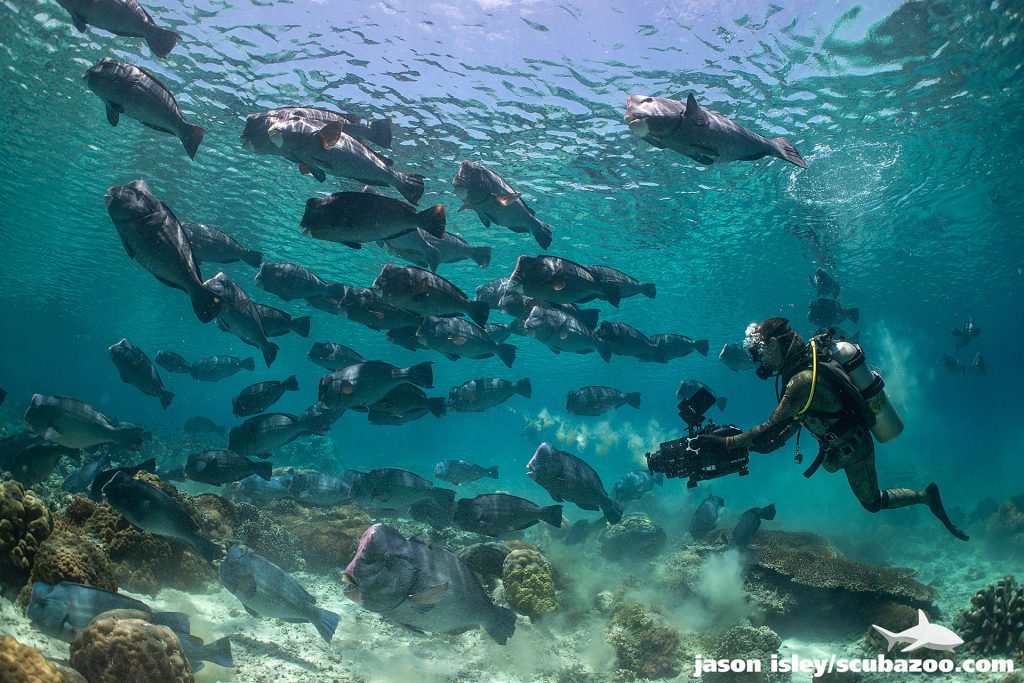
Some of the challenges involved included:
- Diving in near or total darkness
- Poor visibility
- Ripping currents
- Diving at 100ft+ for long periods of time
- Fast moving and unpredictable subjects
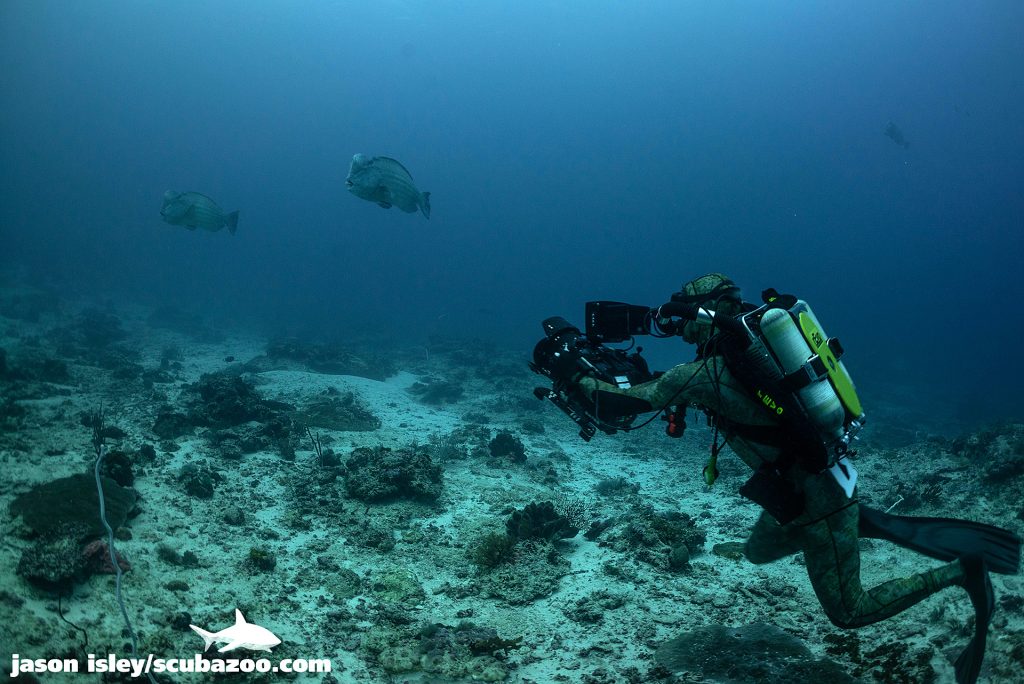
The rutting behaviour happens (as it typical in many animals) in the early hours and at a significant depth. Dawn is a difficult time to work underwater at depth. The light is very low, and due to refraction, very little of it penetrates the surface of the water. Extend that to 100ft (30m) and essentially at least half of our dive was conducted in darkness or twilight. We would usually drop 50m from the main rutting area and have a short ‘commute’ which I would use to check my settings and prepare myself mentally. Filming on-off behaviours is intense and, given I often have only one or two shots at capturing the images I like to pre-visualise what I am going to do and run through potential scenarios in my mind. That way when it happens I’m almost relying on muscle memory. If you stop and think during the action you can lose valuable seconds and valuable opportunity.
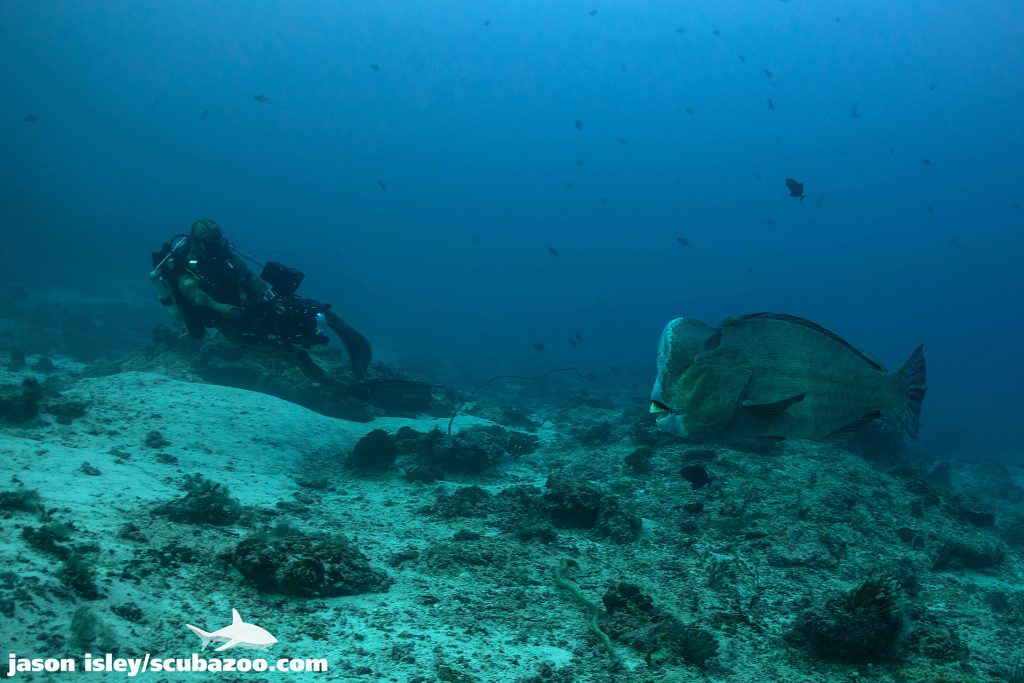
Once arriving at the site we hunkered down and waited for the action to begin. On poor visibility days Jason (my AC) and I would be twisting and turning to try and catch a glimpse as we heard the bangs from collisions in the distance but were unable to see them. Currents were very fickle and could go from nothing to holding-on-for-dear-life within a matter of minutes. Filming in those situations was extremely tricky.
Typically we would be diving at around 100ft (30m) for anywhere between 1-2hrs. This required careful monitoring of our Closed Circuit Rebreathers to ensure we stayed within no-deco limits but did not push our oxygen levels too high either. It was a delicate balancing act.
It’s difficult to adequately describe the rut. The speed and force with which the bumphead parrotfish collide is devastating. I remember the first time I saw it (without getting a shot) Jason and I turned to each other in awe afterwards. We’ve both seen a lot of things underwater but this was something else. The noise was like a car-crash, a kind of boom and crunch. It was visceral and I felt it as much as heard it, very reminiscent of a fish bomb going off nearby.
The first few shoots were frustrating due to poor conditions but finally, on our hail-mary last shoot we were treated to an hour long matchup between two evenly matched 20kg adults. These males went at it again and again in order to prove their dominance. Even to the point that scales were being knocked off! It was truly an epic encounter and meant that I had finally achieved my goal of filming the bumphead parrotfish rut.
When we watched the footage in the evening back we saw puffs of air being produced by those concave heads. This is known as a cavitation effect, similar to that produced by mantis shrimp punching. Extrapolating the video further Steve Simpson (our scientific advisor) and his team estimated the bumpheads are accelerating to 5G before impact. They are working further on producing scientific papers to document the behaviour.

This sequence was filmed in-between lockdown’s in Malaysia across five shoots in 2020 and 2021. We were incredibly fortunate to be able to stay and dive with Scubajunkie Mabul at a time when many of the dive centres in the area were closed. Crew are listed below.
- Producer – Joe Tuck
- Field Director – Oliver Deppert
- Director of Photography – Roger Munns
- Assistant Camera – Jason Isley
- Skipper – Yulo
- Divemaster – Affat